
 LinkT&B Editorial Department

Edge AI runs inference close to a camera or machine. For visual inspection, it can limit network traffic and latency, but image capture, missed defects, device temperature and model updates still need to be designed and tested.
Contents
“I want to use AI, but I'm worried about sending data to the cloud.” “I want to run AI even in the field where the network is unstable.” - Edge AI responds to these needs. It is a technology that executes AI inference processing on on-site devices without sending data to the cloud, and is being introduced in a wide range of industries, including visual inspection in the manufacturing industry, customer analysis in retail, and safety monitoring at construction sites.
In this article, we will explain the basic concept of edge AI, how it differs from cloud AI, typical usage examples, major hardware and frameworks, and decision points for small and medium-sized enterprises when considering introduction.
Conditions for an inspection trial
| Item | What to check | How to assess it |
|---|---|---|
| Imaging | Lighting, lens, distance and orientation | Capture good and defective parts consistently |
| Decision | Defect type, size and tolerance | Measure misses and false rejects separately |
| Timing | Conveyor, capture, inference and rejection | Verify the complete line cycle |
| Operation | Dirt, heat, product changes and updates | Assign maintenance and revalidation |
Edge AI basics: Differences from cloud AI
In the past, the mainstream use of AI was “cloud AI,” which sends data to a server on the cloud, performs inference (or learning) there, and returns the results to the device. Edge AI, on the other hand, performs inference processing directly on devices near cameras and sensors, or at the "edge."
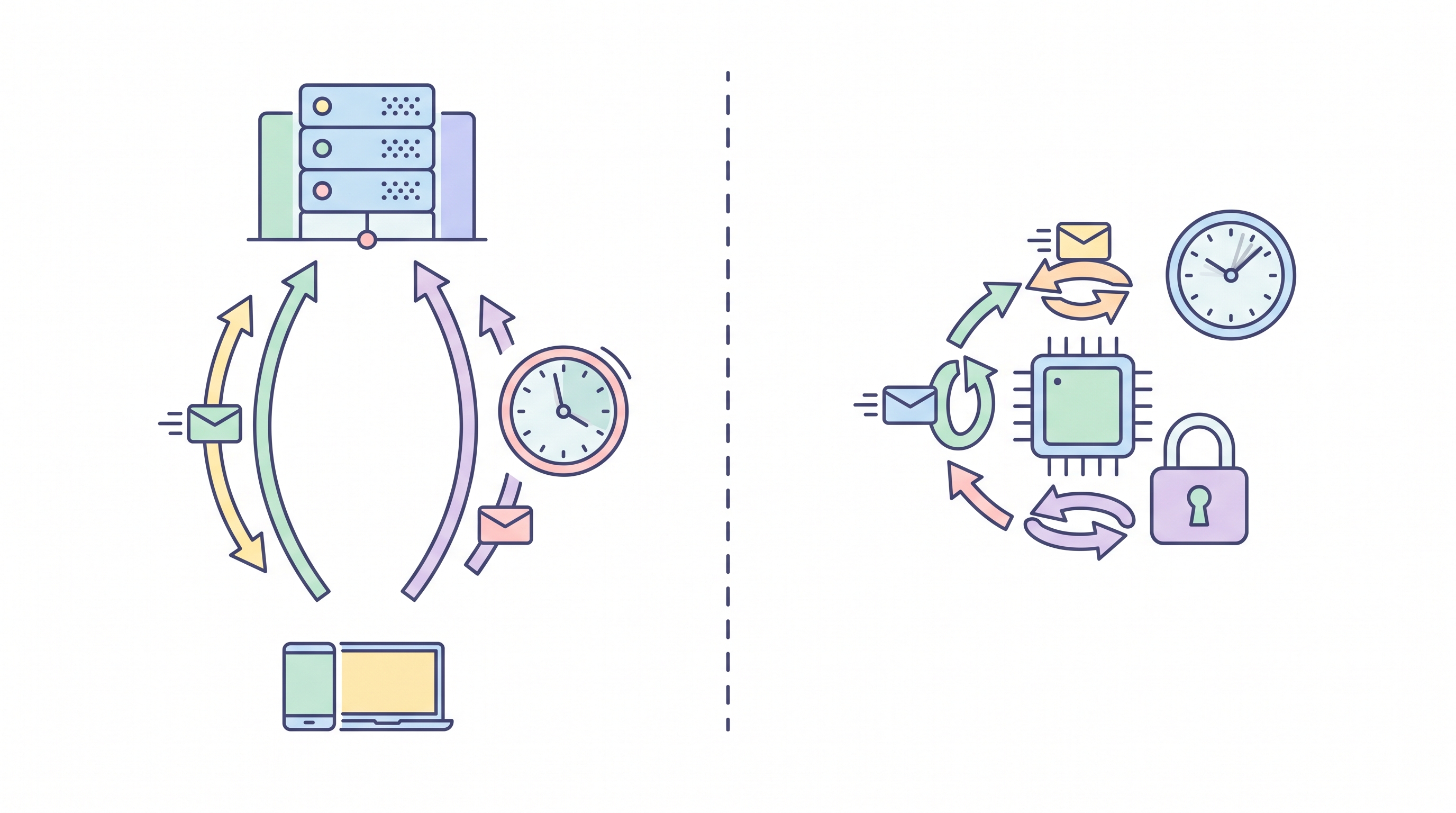
Figure 1. Architecture comparison between cloud AI and edge AI. Edge AI minimizes data movement and completes inference on-site.
| Comparison items | cloud AI | Edge AI |
|---|---|---|
| Processing location | Cloud server (data center) | Field devices (cameras, gateways, etc.) |
| latency | Approximately several hundred ms to several seconds depending on network conditions | A few ms to several tens of ms is possible for small and optimized models (depending on model size and device performance) |
| network dependent | High (continuous connectivity assumed) | Low (can work offline) |
| data privacy | External transmission required | Completed on site (low risk of data leakage) |
| Processing capacity | Almost unlimited (scalable) | Limited device computing power |
| running cost | API usage fees and communication fees are pay-as-you-go | API pay-as-you-go billing and large-capacity communication fees are not required, but operational costs such as maintenance, model updates, monitoring, and failure replacement are incurred. |
The important point is that edge AI and cloud AI are not better, but rather that they should be used depending on the purpose. Processing that requires real-time performance and data processing that is sensitive to privacy will be performed at the edge, while large-scale learning and analysis of past data will be performed in the cloud. These "hybrid configurations" are now a viable option for many implementations.
Four advantages of edge AI
1. Low latency
Edge AI's greatest strength is its response speed. There is no round trip time to send data to the cloud, so results can be returned in milliseconds. Edge AI is a strong option for applications where delays cannot be tolerated, such as obstacle detection in autonomous driving, defective product determination on production lines, and danger detection at construction sites.
2. Ensuring data privacy
Privacy risks can be significantly reduced because processing can be completed within the device without sending data including video data or personal information to an external party. It is especially effective in situations where there are legal and ethical restrictions on data handling, such as analyzing medical images and analyzing the flow of people in an office.
3. Network independent
AI can be used in environments where stable internet connections cannot be expected, such as farmland, construction sites in the mountains, and ships at sea. AI inference does not stop even if the network is interrupted, making it suitable for mission-critical applications.
4. Predictability of running costs
API usage fees for cloud AI increase in proportion to the amount of processing, but with edge AI there are no API fees or large communication fees for each inference. Especially in applications that constantly process large amounts of data, such as surveillance cameras that operate 24 hours a day, the pay-per-use charges for cloud AI can be expensive, and edge AI makes it easier to foresee costs. However, operating costs such as maintaining and replacing faulty edge devices, updating and relearning models, applying security patches, and maintaining a monitoring system are incurred separately, so it is important to compare them in terms of TCO (total cost of ownership).
Application examples by industry
Manufacturing industry: Automation of visual inspection
AI cameras are installed on the production line to detect scratches, discoloration, and shape abnormalities on products in real time. Publicly available cases include Musashi AI introducing AI visual inspection equipment to Toyota Motor Corporation's production line and operating mass production, and HACARUS providing an AI visual inspection solution for FANUC's CRX series of collaborative robots, reducing inspection time to 1/4 of the conventional time. The extent of improvement in inspection speed and accuracy varies depending on the target workpiece, inspection conditions, and AI model design, but in recent years, the price of AI cameras has fallen, making it easier for small and medium-sized parts manufacturers to consider introducing them.
Retail: Visitor analysis and shelf management
Cameras at store entrances and in front of shelves analyze the number of customers, flow lines, and residence time, and use this information to optimize product placement and determine staff allocation. Edge processing eliminates the need to send facial images to the cloud, making it easier to reduce the risk of data leakage or third-party provision. However, even with edge processing, if a specific individual can be identified from a camera image, it falls under the handling of personal information, so it is necessary to separately consider the identification and publication of the purpose of use, design of storage period, inquiry response system, and anonymization processing (refer to the Personal Information Protection Commission's "Usage of Camera Systems with Facial Identification Functions").
Construction/Infrastructure: Safety monitoring
AI cameras are installed at construction sites to detect workers not wearing helmets, entering restricted areas, or approaching heavy machinery, and issue alerts in real time. Edge AI's strength is that it can operate offline even on sites where the network environment is unstable.
Agriculture: Field monitoring and harvest determination
AI models are installed on drones and fixed cameras to perform on-site assessment of crop growth conditions, early detection of pests and diseases, and determination of the appropriate harvest time. Because the network environment is limited in vast farmlands, edge processing is essential.
Medical: Image diagnosis support and vital monitoring
Applications are expanding for screening X-ray and CT images, real-time analysis of vital sensor data in hospital rooms, and immediate alerting of abnormalities. The ability to process patient data without sending it to the cloud is an area that fits well with the confidentiality requirements of medical data.
Mobility/surveillance: autonomous driving and security cameras
Edge AI is also being used in areas that require continuous high-speed judgment, such as obstacle detection for self-driving vehicles and suspicious behavior detection for security cameras in facilities and on the streets. This is a use case where cloud processing is not practical due to both latency and communication costs.
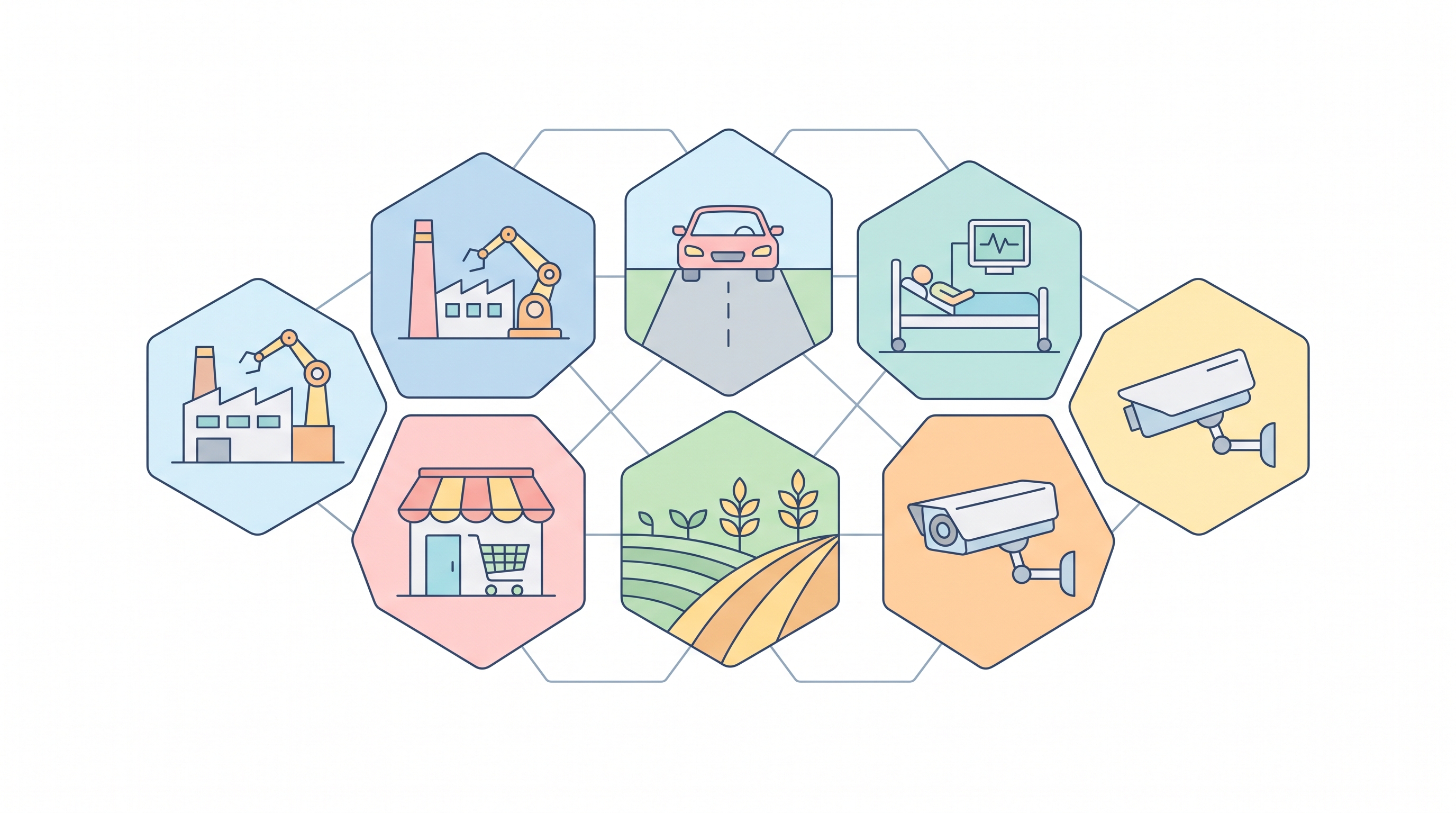
Figure 2. Edge AI utilization map by industry. The need for real-time AI inference is expanding in a wide range of fields, including manufacturing (factory robots and inspection lines), retail, construction, agriculture, medical care, automobiles, and security monitoring.
Typical hardware and frameworks
| device | Manufacturer | Main features | Price range (estimate) |
|---|---|---|---|
| Jetson Orin Nano | NVIDIA | GPU inference, TensorRT support, rich ecosystem | Approximately 30,000 to 50,000 yen (Dev Kit) |
| Jetson Orin NX 16GB | NVIDIA | High-performance GPU, for industrial applications | Approximately 150,000 to 170,000 yen (module alone) |
| Coral Edge TPU | Low power consumption, specialized for TensorFlow Lite / LiteRT (INT8 quantization model only, supported operators are limited) | 10,000 to 30,000 yen | |
| Raspberry Pi 5 + AI HAT+ | Raspberry Pi Foundation | Low cost, for prototypes | Approximately 50,000 to 60,000 yen (8GB main unit + AI HAT + total) |
| Hailo-8 | Hailo | High efficiency NPU, 26TOPS, low power consumption | Varies depending on product form (approximately 23,000 yen for AI HAT+ installed version, 50,000 to 80,000 yen for M.2 module/evaluation board) |
Representative frameworks include TensorFlow Lite (currently being developed as its successor LiteRT), ONNX Runtime, NVIDIA TensorRT, and OpenVINO (Intel). A common workflow is to use these frameworks to optimize (quantize, prune) models learned in the cloud for edge devices, and then deploy them.
* The above price is a guideline for authorized domestic dealers as of April 2026, and may vary depending on inventory status, exchange rate, and purchase form (development kit / single module / mass production price).
Points to consider when deciding whether to introduce
When considering the introduction of edge AI, it will be easier to decide on a policy if you organize it based on the following three decision axes.
First is the requirement for real-time performance. Edge AI is suitable when inference results are required within tens of milliseconds. If a delay of a few seconds is acceptable, cloud AI can also be used.
Second, data confidentiality. Edge processing is essential if data containing images and personal information cannot be sent externally. On the other hand, for less sensitive data such as anonymized text data, cloud AI is easier to implement.
Thirdly, there is the cost structure. If the processing volume exceeds a certain level, cloud AI pay-as-you-go charges will become high, so make a decision after calculating the break-even point. For applications such as 24-hour camera video processing, edge AI tends to reduce API charges, but it is important to compare the TCO including device maintenance, model updates, and on-site support costs.
Summary
Edge AI is not a “cloud AI replacement” but an architectural choice that is the best solution for specific requirements. Where low latency, privacy, offline operation, or cost predictability are important to you, it's worth actively considering edge AI.
Lower hardware prices and mature frameworks are making it an affordable solution for small and medium-sized businesses. A practical approach is to start small with one AI camera and one use case, and expand while checking the effectiveness.
Please contact us
LinkT&B provides one-stop support from edge AI device selection to model optimization to on-site installation and operation. Please visit the IT & AI Solutions page or contact us directly from Contact Us for information on automating visual inspections, introducing AI surveillance cameras, building local LLM, etc.
Reference materials
- NVIDIA, "What Is Edge Computing?"
- NVIDIA, "Jetson Orin series"
- Google, "Coral Edge TPU FAQ"
- Google, "LiteRT (formerly TensorFlow Lite)"
- Intel, "OpenVINO Documentation"
- Raspberry Pi, "AI HAT+"
- Personal Information Protection Commission, "About the use of camera systems with facial recognition function"
- PR TIMES, "Musashi AI Press Release (Toyota AI Visual Inspection Introduction Case Study)"
* The information in this article is as of April 2026. Hardware prices, framework specifications, and legal systems are subject to change, so please check each official website for the latest information.
Related Articles
Five Pitfalls to Avoid When Deploying Generative AI at Work / How Safe Is Cloud AI Data? The Case for Local LLMs / Four Structural Risks in Cloud AI: Rethinking Encryption, VPNs and SaaS
Discuss your project
We support sensor selection, connectivity and embedded design. Tell us what data you need from your existing equipment and where it operates.