
 LinkT&B Editorial Department
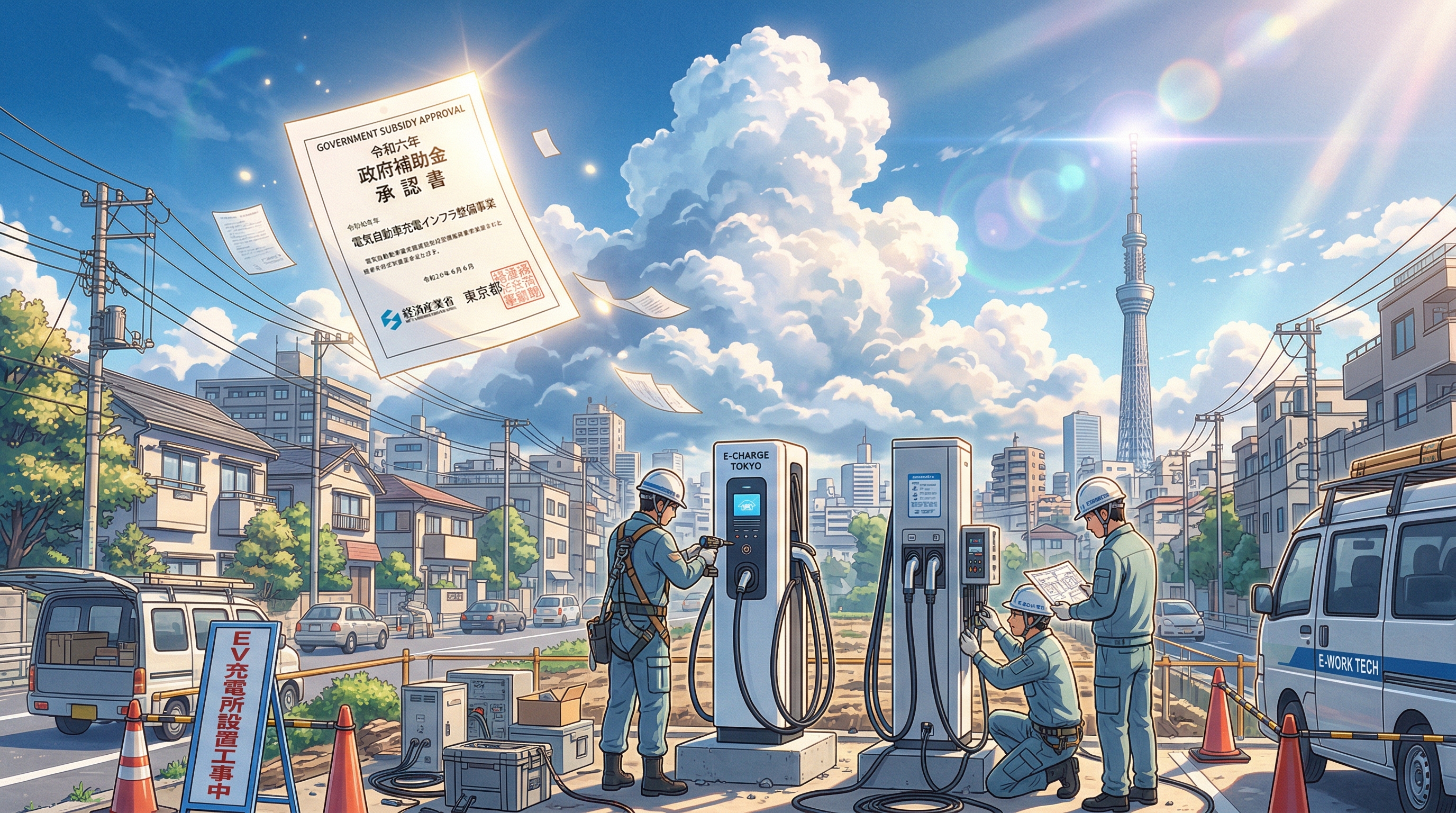
Japanese EV charger grants depend on the equipment, site and application period. Compare the subsidised purchase cost with communications, maintenance, electricity demand charges and relocation or removal conditions.
Contents
Cost categories to align in quotations
| Item | What to check | How to assess it |
|---|---|---|
| Installation | Charger, cabling, foundations and supply | Eligible costs versus own funding |
| Operation | Energy, network, payments and maintenance | Fixed, variable and incident costs |
| Relocation or exit | Transport, new works and restoration | Approval and repayment obligations |
Check the equipment and site before estimating a grant
Charging-equipment support depends on charger type, location, output, connector count and eligible works. Separate equipment, installation and incoming-supply costs. A single flat subsidy assumption can give a misleading estimate of the owner’s contribution.
As of 12 October 2026, Japan’s Next Generation Vehicle Promotion Center lists the first and second application periods for the FY2025 supplementary charging-equipment programme as closed. The detached-house outlet application period is also closed. Guidance on projects spanning fiscal years is available; check the current category and ordering/construction rules before committing. Official application status.
Separate the grant from ongoing operating costs
Inspection, repairs, communications, billing services, electricity and parking management continue after installation. Low utilisation can make each charging session expensive even when a grant reduces the initial equipment cost.
| Stage | Costs to include |
|---|---|
| Installation | Equipment, wiring, distribution board, foundations, supply upgrades and applications |
| Operation | Energy, additional capacity charges, connectivity, payment processing and maintenance |
| Relocation | Electrical work, reconnection and grant-related procedures |
| End of use | Removal, disposal, reinstatement and contract termination |
At leased sites, compare the intended operating period with the property contract. Moving or disposing of grant-funded equipment may require prior approval. Confirm the procedure with the programme administrator before acting.
Fixed and portable equipment suit different operations
Fixed equipment can be appropriate for stable parking locations, with permanent wiring, signage, authentication and maintenance. Select output from parking duration and required energy rather than the maximum rating alone.
Portable equipment may suit trials, events or changing layouts. Portability does not mean compatibility with every supply. Check capacity, earthing, protective devices, connection arrangements and handling access at each location. Neither grant eligibility nor the absence of electrical work follows automatically from portability.
Check whether every vehicle must charge simultaneously
Ten returning vehicles do not necessarily require ten chargers at full power together. Scheduling around the next departure and remaining charge may reduce supply-upgrade requirements. Conversely, several low-power chargers may be inadequate for vehicles making short stops.
LinkT&B can help compare fixed and portable charging arrangements using the site’s electrical conditions, vehicle count and parking schedule.
Discuss your project
We help plan charging equipment, authentication and management around vehicle use and parking time. Tell us about your fleet and existing facilities.