
 LinkT&B Editorial Team
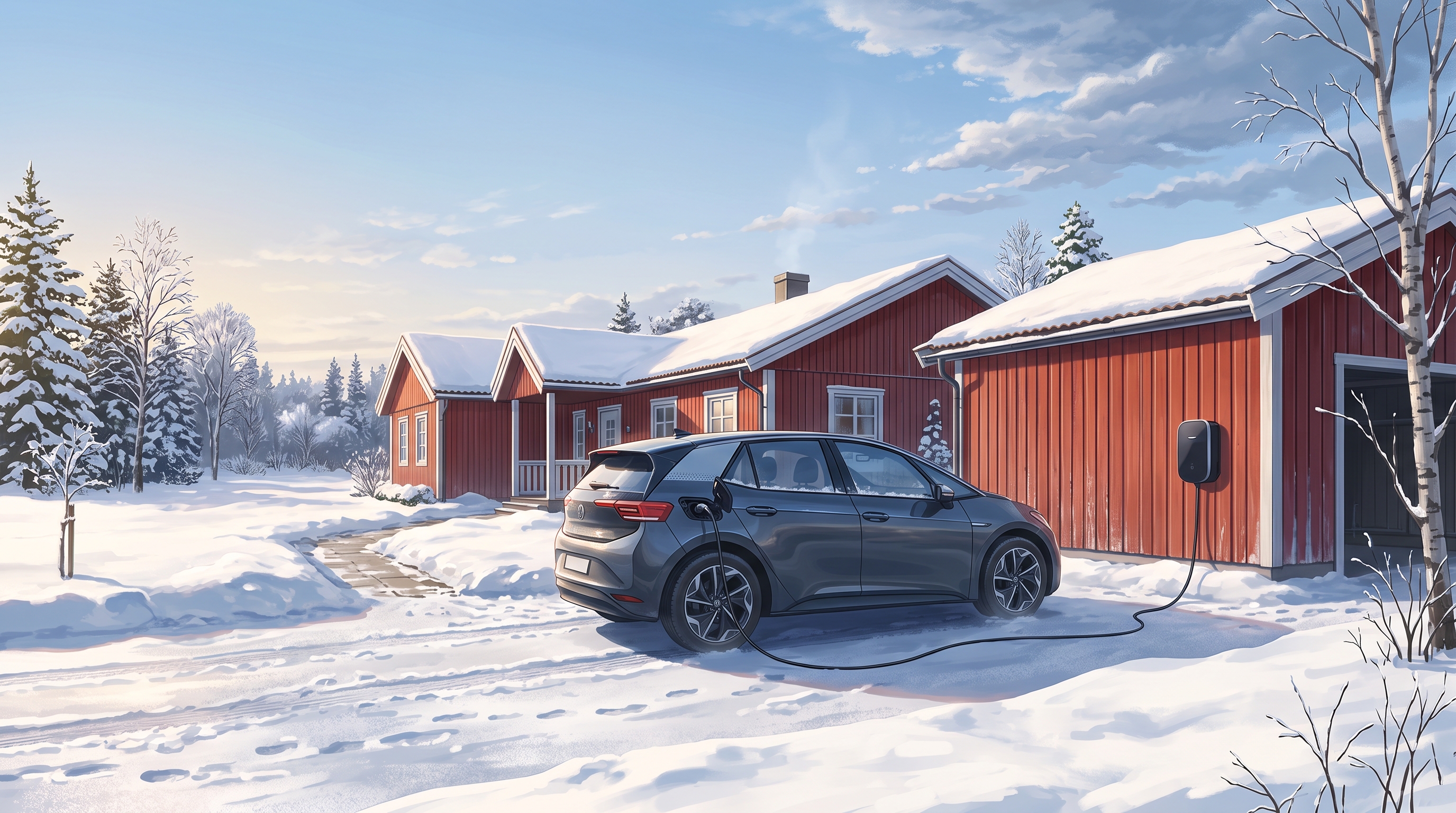
EVs accounted for 95.9% of Norway’s new passenger-car sales in 2025. Purchase tax incentives, home charging and preheating before departure support everyday EV use in a cold climate. Norway’s policies and residential charging examples offer practical ideas for drivers in Japan’s colder regions.
Contents
- EVs reached 95.9% of Norway’s new passenger-car sales in 2025
- Norway reduced registration tax and VAT to make EVs more affordable
- In cold regions, parking-space electricity has long been used to warm engines before departure
- Preheating an EV before departure can warm the cabin and preserve battery energy
- Warming the battery before rapid charging can reduce winter charging time
- Norwegian housing associations have added EV charging to existing parking spaces
- In Japan’s colder regions, combine overnight charging with preheating before departure
- Sources and further reading
- Discuss EV charging equipment and operation
Cold weather can reduce EV range and slow rapid charging. Yet EVs account for almost all new passenger-car sales in Norway, a country with cold winters.
Norway has reduced the cost of buying an EV through tax relief and provided charging at homes and other locations. For drivers, being able to charge after returning home and leave in a warm car on a cold morning is another benefit. We start with the purchase incentives, then look at charging and preheating in winter.
EVs reached 95.9% of Norway’s new passenger-car sales in 2025
Here, EV means a battery-electric vehicle, or BEV, powered entirely by its battery without a combustion engine. According to Norway’s Road Traffic Information Council, OFV, BEVs accounted for 95.9% of new passenger-car sales in 2025 and 97.9% in January–September 2026. [1][2]
The 95.9% figure is the share of newly sold passenger cars that were EVs in 2025. Older combustion-engine cars remain on the road, while EVs have become the mainstream choice for new-car buyers.
Norway reduced registration tax and VAT to make EVs more affordable
Norway’s government has made EVs more affordable by reducing the one-off registration tax and value added tax (VAT) paid on purchase. These measures apply in Norway. VAT is comparable to Japan’s consumption tax, with a standard rate of 25%; an exemption or reduction directly lowers the buyer’s payment.[3][4]
| Start date / period | Measure | Effect on the buyer's tax burden |
|---|---|---|
| 1990–2022 | Exemption from one-off registration tax | EVs were exempt from this tax. Registration tax on combustion-engine cars depends on factors such as weight and emissions, so the saving varies with the vehicle used for comparison.[3] |
| July 2001–December 2022 | Full VAT exemption for EVs | No VAT was charged on the eligible vehicle price. The exemption began when the standard rate was 24% in 2001 and continued during the period when that rate was 25%.[3][5] |
| January 2023–December 2025 | VAT exemption limited to NOK 500,000 | The first NOK 500,000 of the pre-VAT vehicle price was exempt; the excess was taxed at 25%. The maximum saving against ordinary VAT was NOK 125,000 per vehicle.[6] |
| From January 2023 | Weight-based registration tax also applies to EVs | A weight component common to passenger cars also applies to EVs. In 2026 it is NOK 12.71 per kg above 500 kg. EVs remain exempt from the additional CO₂- and weight-based registration tax charged on combustion-engine cars.[7] |
| From January 2026 | VAT exemption reduced to NOK 300,000 | The first NOK 300,000 of the pre-VAT vehicle price is exempt; the excess is taxed at 25%. The maximum saving is NOK 75,000 per vehicle.[6] |
NOK means Norwegian kroner. The VAT relief applies to passenger cars powered solely by an externally rechargeable battery. The next example holds the vehicle’s pre-tax price constant to show how the different tax rules change the amount paid.
For a NOK 600,000 EV, how much does VAT relief reduce the purchase payment?
Assume a vehicle-only price of NOK 600,000 before VAT and a standard VAT rate of 25%. Registration tax, accessories and fees are treated separately; the table compares the vehicle price plus VAT.
| Tax treatment | VAT payable | Vehicle + VAT | Saving against ordinary VAT |
|---|---|---|---|
| Ordinary VAT at 25% | 150,000 | 750,000 | — |
| EV in 2022 | 0 | 600,000 | 150,000 |
| EV in 2023–2025 | 25,000 | 625,000 | 125,000 |
| EV in 2026 | 75,000 | 675,000 | 75,000 |
In 2023–2025, 25% VAT on the NOK 100,000 above the threshold produces a tax bill of NOK 25,000. In 2026, 25% on the NOK 300,000 above the threshold produces NOK 75,000. With the same pre-tax price in this example, the reduced relief in 2026 still lowers the amount paid by NOK 75,000 compared with ordinary VAT.[6]
Looking ahead, the government's proposed 2027 tax budget sets out a reduction in the exemption threshold to NOK 150,000 in 2027 and removal of the exemption in 2028. As of 13 October 2026, these are proposals; the applicable rules are the 2026 measures shown above.[4]
Norway began reducing the purchase tax burden while EVs were still uncommon and has adjusted the incentives as adoption has grown. In our view, combining a lower initial cost with access to everyday charging has helped make EVs a practical choice in a cold climate.
In cold regions, parking-space electricity has long been used to warm engines before departure
Engine oil becomes more viscous at low temperatures, increasing the strain of starting a cold engine. Engine heaters connected to a parking-space electricity supply have been used to reduce that strain.
Norwegian manufacturer DEFA supplies products that heat coolant, engine components or oil, depending on the car. Some systems also include a cabin heater and a 12V battery charger. Drivers used electricity while parked to prepare for departure before EVs became widespread.[8]
At parking spaces equipped with engine-heater outlets, drivers connect the car while parked and warm the engine before leaving. Plugging in while parked to prepare for the next morning is a habit that also fits everyday EV use.
Preheating an EV before departure can warm the cabin and preserve battery energy
Warming an EV’s cabin before getting in lets you leave without waiting for the heater to take effect. Norway’s automobile federation, NAF, recommends preheating before departure. On cars with scheduling, you can set your usual departure time on the vehicle’s screen or in its smartphone app.
When a plugged-in car can draw enough power from the charger for preheating, it preserves energy in the traction battery. Models that preheat both the cabin and battery can also prepare the battery for departure. Check your car’s preheating functions and schedule them for your morning commute.[9]
Warming the battery before rapid charging can reduce winter charging time
A cold battery charges at lower power, so rapid charging can take longer in winter. NAF recommends battery preheating where available, or charging after driving has warmed the battery. If selecting a rapid charger in the navigation system starts preheating, set that destination before leaving. Where preheating is started through a screen or app, start it before heading to the charger so the battery can warm on the way.[10]
On a longer trip, a charger at a planned shopping or rest stop lets you charge during that visit. NAF also recommends charging at places you already intend to stop. Adding enough energy for the next leg while shopping can reduce stops made solely to charge.
Model-specific winter tests can help you choose charging stops for a winter journey. NAF’s 2026 test ran at −15 to −25°C, reaching −32°C in some areas. Use cold-weather range as a guide to choosing a charger you can reach with charge to spare. Identifying another charger nearby gives you an alternative if the first is occupied or unavailable.[11]
Norwegian housing associations have added EV charging to existing parking spaces
In 2019, Norway’s Mellomenga housing association announced plans to add EV charging infrastructure to garages and selected engine-heater parking spaces, and accepted charger orders from residents. This is a concrete example of adding EV charging to spaces previously used for engine preheating. Charging in a home parking space lets residents plug in after returning and use the time before their next trip.[12]
Under the association’s instructions, each charger is linked to a user account, energy use is read automatically and charges are settled monthly. Recording each resident’s charging use allows costs to be billed individually. Planning charging equipment and billing together helps make a shared residential installation practical.[13]
Ola Narr housing association installed 16 charging spaces in 2019. The equipment automatically adjusts current according to how many cars charge at once. Sharing a limited electricity supply among cars is also an option for Japanese apartment buildings and staff housing. Building managers can check the number of cars charging together and their parking duration to select equipment that can supply the energy each car needs.[14]
In Japan’s colder regions, combine overnight charging with preheating before departure
For a daily EV commute in Hokkaido or Tohoku, one option is to charge between returning home and leaving the next morning. Choose a car and charger that can replace the energy used on the winter round trip within that time. You can then plug in after returning, and scheduled preheating can have the cabin warm when you leave.
If you drive throughout the day for sales visits, look for chargers along your route and consider charging over lunch or a break. Compare the afternoon’s driving distance with the amount you can charge during the stop when choosing the location and duration. Combining charging with a meal or break can avoid adding a separate stop solely to charge.
When installing a charger at home or work, choose a position where the cable will reach the car and remain easy to connect on snowy days. Tell the installer where snow will be piled and which routes will be cleared. Keeping the charger out of snow piles and the cable away from those routes makes everyday charging easier.
Sources and further reading
- OFV: new passenger-car registrationsBack to text
- OFV: new passenger-car registrationsBack to text
- Norwegian Government, NOU 2022:20, section 15.2.2: registration tax and VAT historyBack to text 1Back to text 2Back to text 3
- Norwegian Government, proposed 2027 tax budget, section 9.2: proposed phase-out of EV VAT reliefBack to text 1Back to text 2
- Norwegian Government, 2001 budget agreement, items 5.6 and 5.8: EV exemption and standard VAT rateBack to text
- Norwegian Tax Administration, VAT Handbook, section 6-8: NOK 300,000 threshold from January 2026Back to text 1Back to text 2Back to text 3
- Norwegian Tax Administration: one-off registration tax and the weight component introduced in 2023Back to text
- DEFA: electric engine heatersBack to text
- NAF: winter EV use and testingBack to text
- NAF: winter EV use and testingBack to text
- NAF: winter EV use and testingBack to text
- Mellomenga housing association: EV chargingBack to text
- Mellomenga housing association: EV chargingBack to text
- Ola Narr housing association: parking and chargingBack to text
Discuss EV charging equipment and operation
Tell LinkT&B how you plan to use EVs—for example, installing a home charger or charging company vehicles overnight for the next morning. We can propose vehicles, chargers and operating arrangements suited to your parking time, driving distance and installation site.