
 LinkT&B Editorial Department
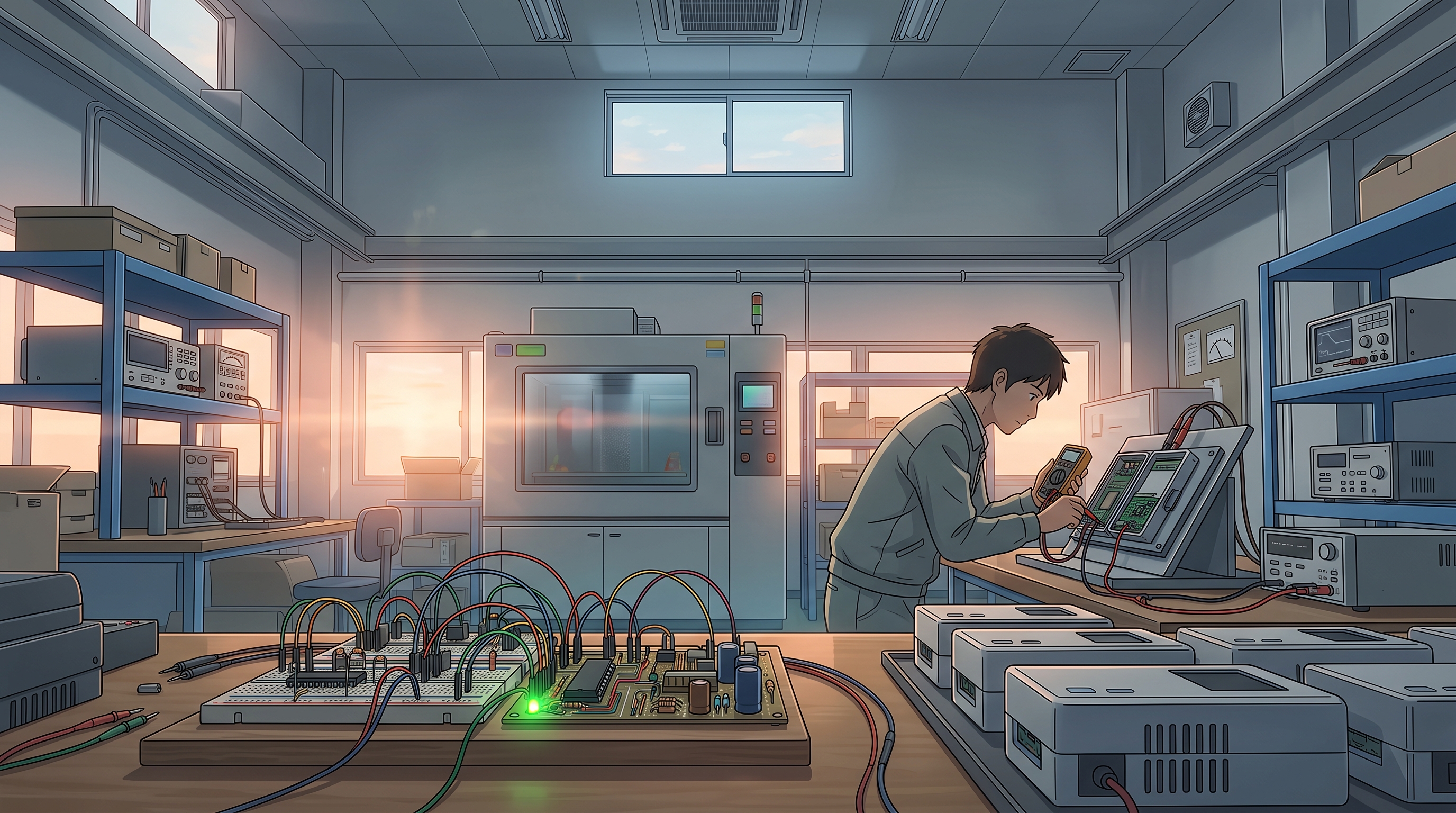
A working prototype leaves questions about component variation, manufacturing, testing, environment and procurement. Productisation means verifying repeatability and providing the design records and test procedures needed to reproduce it.
Contents
- From prototype to repeatable product
- First write down the conditions for “it moved”
- Replace the usage environment with product requirements
- Design not only the normal system but also recovery
- Designed for ease of manufacture and inspection
- Deciding on post-sale updates and maintenance first
- Assemble evaluation before proceeding to mass production
- Information to gather before consultation
- Summary: From operation to conditions for repeated use
- Technical support information
- Related Articles
- Discuss your project
Although the prototype model was able to perform the desired operation, the number of issues increases when trying to move forward with commercialization. It won't work if you change the power supply, it won't come back on if communication is cut off, and the results will be different if someone else assembles it. These problems arise from the difference between checking the core functionality and checking the conditions for continued use as a product.
Successful prototyping is an important step forward, but it cannot be said that manufacturing, installation, operation, and maintenance are complete. In this article, we will clarify the scope of what was confirmed in the prototype, and organize the procedures for returning the usage environment, operation during abnormalities, manufacturing inspection, and post-delivery response to specifications.
From prototype to repeatable product
| Item | What to check | How to assess it |
|---|---|---|
| Design | Tolerances, temperature and supply variation | Validated operating range |
| Manufacturing | Assembly, programming and calibration | Instructions and fixtures |
| Testing | Test points, limits and records | Detection before shipment |
First write down the conditions for “it moved”
In prototyping, we sometimes use specific power supplies, sensors, communication environments, and dummy data to confirm operation. In some cases, the developer operates it and manually corrects the settings as necessary. Separate from the test records what was confirmed and what was established by the work of the person in charge.
For example, if a prototype is able to display sensor values on the screen, it can be said that the sequence of value acquisition, communication, and display has been confirmed. On the other hand, it is not always possible to simultaneously check what to do when communication is interrupted, sensor failure detection, management of multiple devices, and recovery after an update. Avoid converting unconfirmed items into product features.
There is no need to underestimate the results of prototype production. By matching the tested conditions, results, and conditions to be checked next, the results can be used as material for making decisions about commercialization. The purpose is to find the biggest unknown points before moving to a dedicated board or housing.
Replace the usage environment with product requirements
When it becomes a product, it is used by people other than the developer in the intended locations and procedures. Organize the power on/off, ambient temperature, installation method, connection cables, combination with external equipment, etc. If the desktop prototype differs from the actual installation conditions, we will add that difference to the test items.
| stage | Mainly to check | Materials for deciding what to do next |
|---|---|---|
| Simple prototype | Establishment of one function/one data flow | Configuration, operation results, remaining issues |
| Trial in actual use | Actual data, installation conditions, operation | Evaluation results for normal and abnormal conditions |
| product design | Dedicated board, housing, inspection, update | Specifications, manufacturing data, test methods |
| Introduction/operation | Installation, maintenance, restoration, handover | How to keep records of responsibilities, procedures, and history |
Environmental responses vary depending on the target product and application. Check the scope of any required standards, authentications, and customer acceptance conditions on a case-by-case basis. Instead of treating the test as compliant based on the operational results of the prototype, separate the items to be addressed in the design and the items to be evaluated separately.
Design not only the normal system but also recovery
On-site, power outages, communication interruptions, sensor disconnections, and input errors can occur. In addition to stopping when an error occurs, we check whether the user can determine the error, whether records are lost, and whether consistency can be achieved after restarting. Understand conditions that cannot be corrected without the person in charge going to the equipment.
Check the data after communication is restored
If you want to send the values obtained during the communication interruption later, decide how to handle the acquisition time and sending time. Test the possibility that the same record will be duplicated or the order of reception will change due to retransmission. There also needs to be a way to display missing readings and disconnections so that equipment status is not confused with equipment status.
Testing by turning off and turning on the power again checks what happens to settings, time, connections, and saved data. Determine the range that should be restored without any special operation by the user, and the range that can be resumed after inspection. It is also a design condition that safety-related decisions are not automated solely for the sake of convenience.
Designed for ease of manufacture and inspection
Even if one prototype can be adjusted by hand, it does not necessarily mean that many products can be made using the same method. By aligning parts lists, assembly drawings, writing procedures, and initial settings, we reduce confusion for manufacturers. The scope of evaluation should also be determined in the event of parts substitution or design changes.
During manufacturing inspection, we specify what to measure, what functions to operate, and what results will pass the product. If the configuration requires opening the case many times for inspection or requiring a dedicated environment for the developer, it may be necessary to review the inspection terminals, jigs, and operating procedures. It is easier to organize inspections by including them at the design stage rather than adding them after production.
We will match the individual product identification with the version of the circuit, software, and settings. By linking test results at the time of shipment to an individual, you can check the configuration and inspection history of the target in the event a problem occurs on site. This enables operations to handle the possibility that even devices with the same appearance may have different internal versions.
At the stage of making a small number of units, it is effective to have the person in charge of assembly and inspection follow the documentation. You'll find adjustments that only developers know about and operations that were previously covered verbally. Compare the results of multiple machines and return to the manufacturing procedure and design where the results change due to differences in parts or work.

Deciding on post-sale updates and maintenance first
Being able to update software and being able to safely update it are two different things. Identify updates, decide who approves them, when to apply them, and how to recover from failures along the way. The extent to which it is possible to revert to the previous version is also subject to evaluation, such as whether to keep the settings or initialize them.
For IoT products, post-sales security is also an issue that connects design and operation. IPA's "Security Design Guide for IoT Development" covers threat analysis at the design stage as well as vulnerability countermeasures at the operational stage. We will consider product lifespan, renewal methods, contact information, and initialization at the time of disposal. Reference: IPA IoT development security design guide.
Logs and status displays that can be checked by maintenance personnel are also required. Rather than saving everything, separate the information needed to isolate the cause from the information that should not be saved. The scope of on-site and remote support, setting recovery after replacement, and information necessary for inquiries will be left as a handover procedure.
We also check whether the connection settings used in the prototype can be replicated as is for all products. Separate information for each individual, common initial values, and values that can be changed depending on the installation location. By deciding what to do with the data that will remain in the previous unit when replacing it, and how to initialize it when it is returned or disposed of, you can prevent management from becoming ambiguous during maintenance.
Assemble evaluation before proceeding to mass production
In the evaluation of commercialization, for each requirement, we connect the parts addressed in the design, the tests to be confirmed, and the pass/fail conditions. By looking at core functions, environmental conditions, abnormalities, manufacturing inspection, and updates/maintenance in one evaluation plan, you can find any requirements that remain unchecked.
When a question comes up on an exam, consider where to solve it: circuits, software, structure, or operation. Even if the problem can be avoided by temporary manual operation, it will not be treated as established as a product specification. After implementing the changes, we fix the target version, check the functions affected by the changes, and then reflect them in the manufacturing materials.
At the time of delivery, we will not only have a working unit, but also the agreed upon design materials, test results, and configuration/update procedures. By clearly specifying evaluation conditions and exclusions, you can decide which additional conditions to check even when the scope of use expands.
The list of ratings shows items that are confirmed, unconfirmed, and conditionally confirmed. For example, even if communication operation has been confirmed, if long-term operation or recovery after an update failure has not been confirmed, each status will be left. Rather than summarizing everything as "operation confirmed", you can find out the specific conditions that are stopping commercialization.
Information to gather before consultation
- Parts, data, circuit/software versions and test results used in prototype production
- Users, installation location, number of units, operation period, connection conditions with external devices
- Normal operation and recovery conditions such as power outage, communication interruption, and incorrect operation
- Persons in charge of manufacturing, installation, and maintenance, as well as necessary materials and inspection methods
Summary: From operation to conditions for repeated use
To progress from prototype to product, we start with the functions that have worked, and then add conditions for use environment, abnormalities, manufacturing, updates, and maintenance. By separating confirmed and unconfirmed products and matching requirements and tests, you can specify the processes that are missing in commercialization and the next verification.
Technical support information
At LinkT&B, you can consult with us about circuit/embedded design, prototyping/evaluation, manufacturing inspection, and development with an eye on operation. For more information, please see R&D/Power Electronics Business, and for individual consultation, please see Contact Us.
Related Articles
Starting a Development Project Without a Specification
How to Add IoT to Existing Equipment
Discuss your project
We support circuit design, prototyping and hardware testing. Tell us about the operating conditions and the problem you need to investigate.